
We're learning SoySaves.
A pooled analysis of 9,514 women published in the American Journal of Clinical Nutrition found that women who consumed the most soy were 25% less likely to see their breast cancer return compared to those who avoided it.
And an analysis of 14 separate studies showed that an increased intake of soy resulted in a 26% reduction in prostate cancer risk for men.
Soy is such a big deal, it's now playing in theaters . . .
Only 28% of women know that healthful foods can reduce the risk of breast cancer. That’s why tennis legend Venus Williams and renowned breast cancer surgeon Kristi Funk, MD, are partnering with the Physicians Committee for Responsible Medicine (PCRM) and is now showing throughout October at AMC Theatres around the country—to share the cancer-fighting power of a plant-based diet, including soy specifically.
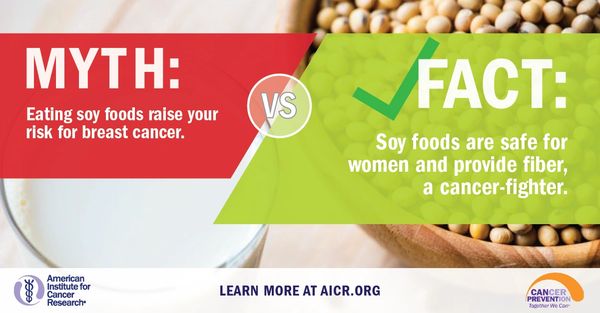

it's featured by leading cancer researchers as beneficial
The American Institute for Cancer Research (AICR) shares, "Soy foods are safe for women and provide fiber, a cancer-fighter."
it's featured by leading medical teams and nutritionists,
Researcher Mark Messina, PhD, joins "The Weight Loss Champion" Chuck Carroll to clear up the biggest myths surrounding soy in this recent podcast and video hosted by PCRM.
Additional References
- Wu AH, Yu MC, Tseng CC, Pike MC. Epidemiology of soy exposures and breast cancer risk. Br J Cancer. 2008;98:9-14. doi:10.1038/sj.bjc.6604145
- Xie Q, Chen ML, Qin Y, et al. Isoflavone consumption and risk of breast cancer: a dose-response meta-analysis of observational studies. Asia Pac J Clin Nutr. 2013;22:118-127. doi:10.6133/apjcn.2013.22.1.16
- Chen M, Rao Y, Zheng Y, et al. Association between soy isoflavone intake and breast cancer risk for pre- and post-menopausal women: a meta-analysis of epidemiological studies. PLoS ONE. 2014;9:e89288-e89298. doi:10.1371/journal.pone.0089288
- Korde LA, Wu AH, Fears T, et al. Childhood soy intake and breast cancer risk in Asian American women. Cancer Epidemiol Biomarkers Prev. 2009;18:1050-1059. doi:10.1158/1055-9965.EPI-08-0405
- Shu XO, Jin F, Dai Q, et al. Soyfood intake during adolescence and subsequent risk of breast cancer among Chinese women. Cancer Epidemiol Biomarkers Prev. 2001;10(5):483-488.
- Lee SA, Shu XO, Li H, et al. Adolescent and adult soy food intake and breast cancer risk: results from the Shanghai Women's Health Study. Am J Clin Nutr. 2009;89(6):1920-1926. doi:10.3945/ajcn.2008.27361
- Zhang FF, Haslam DE, Terry MB, et al. Dietary isoflavone intake and all-cause mortality in breast cancer survivors: The Breast Cancer Family Registry. Cancer. 2017;123(11):2070-2079. doi:10.1002/cncr.30615
- Caan BJ, Natarajan L, Parker B, et al. Soy food consumption and breast cancer prognosis. Cancer Epidemiol Biomarkers Prev. 2011;20:854- 858. doi:10.1158/1055-9965.EPI-10-1041
- Shu XO, Zheng Y, Cai H, et al. Soy food intake and breast cancer survival. JAMA. 2009;302:2437-2443. doi:10.1001/jama.2009.1783
- Magee PJ, Rowland I. Soy products in the management of breast cancer. Curr Opin Clin Nutr Metab Care. 2012;15:586-591. doi:10.1097/MCO.0b013e328359156f
- Guha N, Kwan ML, Quesenberry CP Jr, Weltzien EK, Castillo AL, Caan BJ. Soy isoflavones and risk of cancer recurrence in a cohort of breast cancer survivors: The Life After Cancer Epidemiology study. Breast Cancer Res Treat. 2009;118:395-405. doi:10.1007/s10549-009-0321-5
- Nechuta SJ, Caan BJ, Chen WY, et al. Soy food intake after diagnosis of breast cancer and survival: an in-depth analysis of combined evidence from cohort studies of US and Chinese women. Am J Clin Nutr. 2012;96:123-132. doi:10.3945/ajcn.112.035972
- Messina MJ, Loprinzi CL. Soy for breast cancer survivors: a critical review of the literature. J Nutr. 2001;131(11 Suppl):3095S-3108S. doi:10.1093/jn/131.11.3095S
- Nechuta SJ, Caan BJ, Chen WY, et al. Soy food intake after diagnosis of breast cancer and survival: an in-depth analysis of combined evidence from cohort studies of US and Chinese women. Am J Clin Nutr. 2012;96:123-132. doi:10.3945/ajcn.112.035972
- Kang X, Zhang Q, Wang S, Huang X, Jin S. Effect of soy isoflavones on breast cancer recurrence and death for patients receiving adjuvant endocrine therapy. CMAJ. 2010;182:1857-1862. doi:10.1503/cmaj.091298
- Badger TM, Ronis MJ, Simmen RC, Simmen FA. Soy protein isolate and protection against cancer. J Am Coll Nutr. 2005;24:146S-149S. doi:10.1080/07315724.2005.10719456
- Yang G, Shu XO, Li HL, et al. Prediagnosis soy food consumption and lung cancer survival in women. J Clin Oncol. 2013;31:1548-1553. doi:10.1200/JCO.2012.43.0942
- Myung SK, Ju W, Choi HJ, Kim SC; Korean Meta-Analysis (KORMA) Study Group. Soy intake and risk of endocrine-related gynaecological cancer: a meta-analysis. BJOG. 2009;116:1697-1705. doi:10.1111/j.1471-0528.2009.02322.x
- Schimazu T, Inoue M, Sasazuki S, et al. Isoflavone intake and risk of lung cancer: a prospective cohort study in Japan. Am J Clin Nutr. 2010;91:722-728. doi:10.3945/ajcn.2009.28161
- Barnard ND, Kahleova H, Holtz DN, et al. A dietary intervention for vasomotor symptoms of menopause: a randomized, controlled trial. Menopause. 2023;30(1):80-87. doi:10.1097/GME.0000000000002080
- Kahleova H, Holtz DN, Strom N, et al. A dietary intervention for postmenopausal hot flashes: a potential role of gut microbiome. An exploratory analysis. Complement Ther Med. 2023;79:103002. doi:10.1016/j.ctim.2023.103002
- Mitchell JH, Cawood E, Kinniburgh D, Provan A, Collins AR, Irvine DS. Effect of a phytoestrogen food supplement on reproductive health in normal males. Clin Sci (Lond). 2001;100:613-618.
- Kurzer MS. Hormonal effects of soy in premenopausal women and men. J Nutr. 2002;132:570S-573S. doi:10.1093/jn/132.3.570S
- Strom BL, Schinnar R, Ziegler EE, et al. Exposure to soy-based formula in infancy and endocrinological and reproductive outcomes in young adulthood. JAMA. 2001;286:807-814. doi:10.1001/jama.286.7.807
- Segovia-Siapco G, Pribis P, Messina M, Oda K, Sabaté J. Is soy intake related to age at onset of menarche? A cross-sectional study among adolescents with a wide range of soy food consumption. Nutr J. 2014;13:54-63. doi:10.1186/1475-2891-13-54
- Hamilton-Reeves JM, Vazquez G, Duval SJ, Phipps WR, Kurzer MS, Messina MJ. Clinical studies show no effects of soy protein or isoflavones on reproductive hormones in men: results of a meta-analysis. Fertil Steril. 2010;94:997-1007. doi:10.1016/j.fertnstert.2009.04.038
- Yan L, Spitznagel EL. Soy consumption and prostate cancer risk in men: a revisit of a meta-analysis. Am J Clin Nutr. 2009;89:1155-1163. doi:10.3945/ajcn.2008.27029
- Hwang YW, Kim SY, Jee SH, Kim YN, Nam CM. Soy food consumption and risk of prostate cancer: a meta-analysis of observational studies. Nutr Cancer. 2009;61:598-606. doi:10.1080/01635580902825639
- Nagata C, Takatsuka N, Kawakami N, Shimizu H. Soy product intake and premenopausal hysterectomy in a follow-up study of Japanese women. Eur J Clin Nutr. 2001;55:773-777. doi:10.1038/sj.ejcn.1601223
- Atkinson C, Lampe JW, Scholes D, Chen C, Wähälä K, Schwartz SM. Lignan and isoflavone excretion in relation to uterine fibroids: a case-control study of young to middle-aged women in the United States. Am J Clin Nutr. 2006;84(3):587-93. doi:10.1093/ajcn/84.3.587
- Atkinson C, Lampe JW, Scholes D, Chen C, Wahala K, Schwartz SM. Lignan and isoflavone excretion in relation to uterine fibroids: a case-control study of young to middle-aged women in the United States. Am J Clin Nutr. 2006;84:587-593. doi:10.1093/ajcn/84.3.587
- Messina M, Redmond G. Effects of soy protein and soybean isoflavones on thyroid function in healthy adults and hypothyroid patients: a review of the relevant literature. Thyroid. 2006;16:249-258. doi:10.1089/thy.2006.16.249
- Divi RL, Chang HC, Doerge DR. Anti-thyroid isoflavones from soybean: Isolation, characterization, and mechanisms of action. Biochem Pharmacol. 1997;54:1087-1096. doi:10.1016/s0006-2952(97)00301-8
- Wu SH, Shu XO, Chow WH, et al. Soy food intake and circulating levels of inflammatory markers in Chinese Women. J Acad Nutr Diet. 2012;112:996-1004. doi:10.1016/j.jand.2012.04.001
- Taku K, Umegaki K, Sato Y, Taki Y, Endoh K, Watanabe S. Soy isoflavones lower serum total and LDL cholesterol in humans: a meta-analysis of 11 randomized controlled trials [published correction appears in Am J Clin Nutr. 2007 Sep;86(3):809]. Am J Clin Nutr. 2007;85(4):1148-1156. doi:10.1093/ajcn/85.4.1148
- Zhan S, Ho SC. Meta-analysis of the effects of soy protein containing isoflavones on the lipid profile. Am J Clin Nutr. 2005;81(2):397-408. doi:10.1093/ajcn.81.2.397
- Li SS, Blanco Mejia S, Lytvyn L, et al. Effect of plant protein on blood lipids: a systematic review and meta-analysis of randomized controlled trials. J Am Heart Assoc. 2017;6:E1-E51. doi:10.1161/JAHA.117.006659
- Koh WP, Wu AH, Wang R, et al. Gender-specific associations between soy and risk of hip fracture in the Singapore Chinese Health Study. Am J Epidemiol. 2009;170:901-909. doi:10.1093/aje/kwp220
- Zhang X, Shu XO, Li H, et al. Prospective cohort study of soy food consumption and risk of bone fracture among postmenopausal women. Arch Intern Med. 2005;165:1890-1895. doi:10.1001/archinte.165.16.1890
- Messina M, Sievenpiper JL, Williamson P, Kiel J, Erdman JW. Perspective: soy-based meat and dairy alternatives, despite classification as ultra-processed foods, deliver high-quality nutrition on par with unprocessed or minimally processed animal-based counterparts. Adv Nutr. 2022;13(3):726-738. doi:10.1093/advances/nmac026
as noted by the Physicians Committee for Responsible Medicine,
"New research addresses myths surrounding soy intake in an article published in Critical Reviews in Food Science and Nutrition. The authors note that concerns over the safety of isoflavones, phytoestrogens found in soy products, were largely based on nonhuman animal studies that did not reflect human biology. Researchers reviewed 417 reports based on human data on isoflavone intake and endocrine-related health outcomes. Evidence suggests isoflavone intake does not adversely affect thyroid function, estrogen levels, ovulation in women, or semen levels in men. These publications also showed no negative effects in children. These results suggest neither isoflavones nor soy foods should be classified as endocrine disruptors associated with disease and adverse health outcomes. Soy products are actually associated with reduced risk of breast and prostate cancer."
Many of our leading causes of illness like cancer, heart disease and type 2 diabetes are actually preventable and in some cases reversible through the foods we eat. Join us as we discover in leading science and medicine how we're actually Growing the Cure locally in South Carolina.
Copyright © 2026 The Good Fruit Foundation
This website uses cookies.
We use cookies to analyze website traffic and optimize your website experience. By accepting our use of cookies, your data will be aggregated with all other user data.